Did You Know? The average American child consumes over 5 servings of pesticides EVERY DAY through food.
Is this what you want in your family's food?

GRAS
Reform Updates

"So what’s the big deal? Well, it’s the first food regulation proposed by the MAHA administration, and it closes the GRAS loophole. What it does NOT do is keep unsafe additives out of the food supply. Companies still have plenty of leeway to put whatever they want in their products. This is not pre-market approval. The FDA says it has no statutory authority to require that." Marion Nestle

H.R.4958, the Grocery Reform And Safety Act (GRAS Act) would change a law that has been on the books since 1958 that allows food companies to self-certify common ingredients as “generally recognized as safe,” or GRAS.
The designation was originally intended to provide a pathway to market a narrow set of commonplace, safe ingredients, like water, salt, and baking soda.
However, in the decades since the category was created, it has been exploited as a loophole to bypass food safety review and introduce chemicals into food products.
This leaves the American public and federal regulators in the dark as to what is in our food.
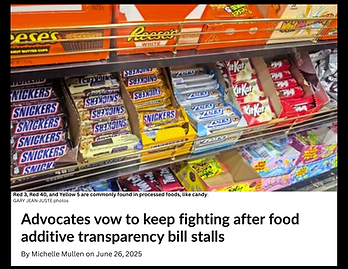
Despite widespread community backing and bipartisan sponsorship, the legislation was shelved during a procedural vote late in the session. It was proposed by Sen. Brian Kavanagh and Assemblywoman Anna Kelles, both Democrats.
The bill also carried significance for researchers. Without comprehensive data on food additives, the scientific study of potential health effects remains limited.
“A public database would be a game-changer for public-health research,” Jose said.
The failed legislation highlights the challenges of regulating an industry resistant to oversight. Yet the community’s message remains clear: Families deserve transparency and safety.
“We’re not giving up,” Rachel Berman said. “Parents deserve to trust the food they feed their children.”
With the next legislative session in January 2026, advocates are hopeful the bill will return stronger.
“If public support stays high, this will pass,” Jose said.

West Virginia lawmakers have made history by passing a groundbreaking bill that bans a slate of artificial food dyes and preservatives, positioning the state as a trailblazer in the fight for safer food.
House Bill 2354, approved by the state Senate on March 5, 2025, with a 31-2 vote, prohibits the sale of food products containing seven synthetic dyes and two preservatives, citing health concerns for children and families. The measure, which cleared the House of Delegates on Feb. 28 with a 93-5 vote, now awaits reconciliation over its effective date before heading to Gov. Patrick Morrisey’s desk for final approval.